
What is missing in the government are people with enough weight in the system who can give quality economic advice, and offer subject expertise, says T N Ninan.
It is odd how governments don't learn from their predecessors' mistakes, says T N Ninan.
The disconnect with the AAP is that its economic agenda sounds suspiciously like Indira Gandhi's of the early 1970s: more subsidies, higher taxes, regulation of private school fees, free water, et al.

The promise of a less suspicious government is surprising. What about the disconnect between the new business stance and earlier push to dictate the narrative in politics and public life, wonders T N Ninan.
The original big boys (Tata, Birla, Ambani) were not the stars of the decade.
A faltering economy may have led to a re-think on economic strategy. And Mr Modi might think he is politically strong enough to take some risks. But there could be a minefield ahead, observes T N Ninan.
Focusing on low GDP growth in recent years, therefore, masks the deeper crisis facing manufacturing and mining.

Whether one likes it or not, services constitute the value-addition sector that the country has to build on, using its comparative advantage in infotech and related skills, suggests T N Ninan.
Forget the big-ticket stuff, for years we have not even been able to dredge Mumbai harbour so that submarines can move in and out round the clock, rues T N Ninan
If P Chidambaram's Budget speech was an hour-long attempt at presenting his government's and his own record in a good light - as he is perfectly entitled to do - such a "marketing" effort invites the recounting of an alternative retelling of the record.

That's because India does not have a serious venture capital industry with an appetite for risk, observes T N Ninan.
The relatively poor performance of government-owned banks comes at a cost to taxpayers.
The poor quality of the initial statistics must take some of the blame for the flak that the government has been getting; growth rates have been recorded as plunging more than they may in fact have.

The only feasible way to have a healthy banking sector could be making it mostly private, along with two or three large, better-run government banks, suggests T N Ninan.
In March 2012, the rupee was about 51 to the US dollar - not much cheaper than it was a decade earlier.

Even as both India and the world struggle to re-build after COVID-19, they face slow-burn problems that could develop into full-blown crises, observes T N Ninan.
All those who have been dismayed by the food security ordinance should thank Manmohan Singh and his colleagues for a neat optical trick, says T N Ninan.

So far, there seems to be limited debate about their activities in India, where virtually all FAANG companies have teamed up in different ways with India's most powerful businessman, observes T N Ninan.

Business has paid a pittance for farmers' land, indulged in widespread illegal mining, and cheated on 'green' commitments.
The market is holding up pretty well in the face of a lot of bad news.
These six people have created a political climate more difficult for business, indeed more hostile to business, than at any time since the mid-1980s.
The one fact of life that will be unchanged into the foreseeable future is that India will remain hugely import-dependent for energy, while rival countries are booking sources of supply, or blocking other sources through trade embargoes.

>The farmers will go home but the country will not get the agricultural reform it badly needs -- if nothing else, then to prevent a bigger water crisis than already exists, argues T N Ninan.
Most people don't know that India is an agricultural power in world markets, says T N Ninan.

The people in both places have lived in a state of denial, refusing to accept the bald fact that resorting to violence against an infinitely superior force is suicidal, observes T N Ninan.
The country has learnt that corruption in defence deals is a fact of life, and has to be dealt with maturely, says T N Ninan
There will be even less Teflon left if the court asks the joint secretary concerned in the Prime Minister's Office to testify who instructed him to vet the CBI's report to the court, says T N Ninan

Tarun Das and T N Ninan offer their prognosis for US-India momentum on the economic front
Bill Clinton's address had lessons for both Rahul Gandhi and Narendra Modi, says T N Ninan
'Food security' will, unfortunately, become a giant boondoggle.
How long will the RBI allow the government to borrow cheaply? A change in policy direction will see rates climb and bond values fall. Investors in debt funds are therefore at risk, as are people invested in the heated stock market, warns T N Ninan.
If Home Minister P Chidambaram is to win acceptability for the top job, he needs to demonstrate that he can establish working relations with people of different political persuasions, says TN Ninan

Both India and China talk now of self-reliance when their external trade, in relation to GDP, has been falling for some years, points out T N Ninan.
While much attention has been devoted to interest rates and industrial revival, the bigger problem for the economy could be its external vulnerability.
Politicians need to wake up. Many of them have functioned as though they were above the law -- and indeed they were. But things have changed -- substantially, not wholly, notes T N Ninan.
The country's mood at the end of 2012 is markedly different from that at the end of 2011. Bread and butter issues, not corruption, have become the focus of attention, says T N Ninan
Country's mood at the end of 2012 is markedly different from that at the end of 2011.
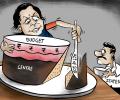
Every option before the finance minister comes with a price tag, observes T N Ninan.
The coal scandal began with revelations about the Manmohan Singh government, then expanded in scope to take in the Vajpayee government, and has now become a sweeping saga that lays bare the contemporary Indian state.

If credit card delinquency spells trouble, there may be questions with regard to the much bigger retail sub-categories of car and housing loans, notes T N Ninan.
